One of the questions we are most frequently asked is what separates a professional bug sweep from checking a property with a consumer device bought online. The honest answer is: the equipment, the calibration, the training to interpret the results, and the methodology. This article explains the professional equipment used in our sweeps and why each component matters.
Radio Frequency Detectors
RF detectors are the foundation of any bug sweep, because the most common category of surveillance device — audio transmitters, RF cameras, GSM bugs — transmits a signal that an RF detector can identify. Professional RF detectors cover a broad frequency range, from the very low frequencies used by some older devices through to the multi-gigahertz frequencies used by modern Wi-Fi-connected cameras.
The key difference between professional RF detection equipment and the consumer devices available for a few tens of pounds online is sensitivity, frequency range, and the ability to distinguish between a genuine surveillance device signal and the background RF noise produced by mobile phones, Wi-Fi routers, smart TVs, and other domestic electronics. A consumer device will alert on almost everything; a professional unit, in the hands of a trained operative, will identify anomalous signals that warrant further investigation.
Non-Linear Junction Detectors (NLJD)
The NLJD is one of the most important tools in a professional sweep because it is not fooled by devices that are switched off or that do not transmit. It detects the presence of semiconductor junctions — the electronic components present in any electronic device — within objects and building materials, regardless of whether the device is active.
This means that a recording device with a local memory card that is waiting to be collected will be identified by the NLJD even though it produces no RF signal and no network traffic. Consumer detection equipment has no equivalent capability.
Camera Lens Detectors
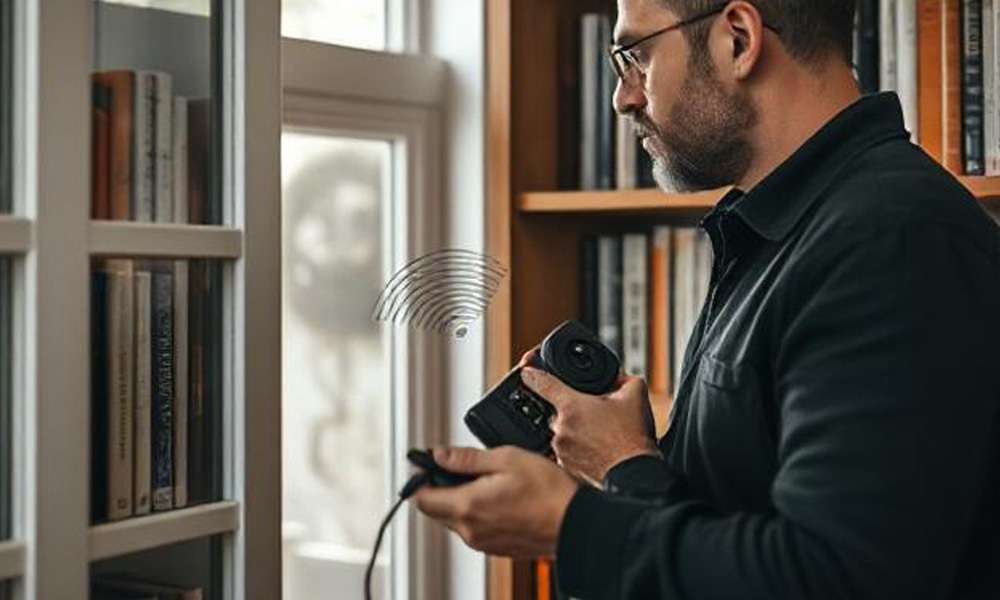
Camera lens detection equipment works by illuminating the area with a specific wavelength of light and identifying the distinctive retroreflective response produced by camera lenses. A camera concealed within an everyday object — a smoke detector, a clock, a USB charger — will have its lens identified even if the device is not transmitting and contains no detectable semiconductor junction accessible from the surface.
Professional camera lens detectors are sensitive enough to identify lenses as small as a millimetre in diameter at distances of several metres, making them effective even where the device has been concealed with care.
Spectrum Analysers
For more detailed RF investigation, a spectrum analyser displays the full picture of RF activity across a defined frequency range, allowing a trained operative to identify and characterise every signal present in the environment. This is particularly useful in environments with significant legitimate RF traffic, where a simpler RF detector might struggle to identify a surveillance device signal against the background noise.
Thermal Imaging
Thermal imaging cameras can identify the heat signature produced by active electronic devices concealed within objects or building materials. A listening device that is continuously powered will generate some heat, and a thermal camera can identify that heat signature through a wall or within an object without physical disassembly. Thermal imaging is most useful as a targeted tool in areas flagged by other detection methods.
Network Scanning Tools
For the network analysis component of a residential sweep, we use professional network scanning tools that identify every device connected to the property’s Wi-Fi network, together with information about each device’s manufacturer, type, and traffic pattern. Devices that cannot be identified as legitimate household electronics are flagged for further investigation.
Why Consumer Devices Are Not Enough
Consumer bug detectors available online cost between ten and one hundred pounds and detect a limited range of RF frequencies with low sensitivity. They produce frequent false positives from legitimate electronics and will miss devices that are not currently transmitting, devices that use frequency-hopping technology, and devices that record locally without any RF transmission at all. They have no NLJD capability, no camera lens detection, and no network analysis.
A sweep conducted with consumer equipment gives a false sense of reassurance. A professional sweep using calibrated equipment and trained operatives gives you an accurate answer.
For a sweep conducted with professional-grade equipment by trained specialists, contact ARF Private Investigators.