
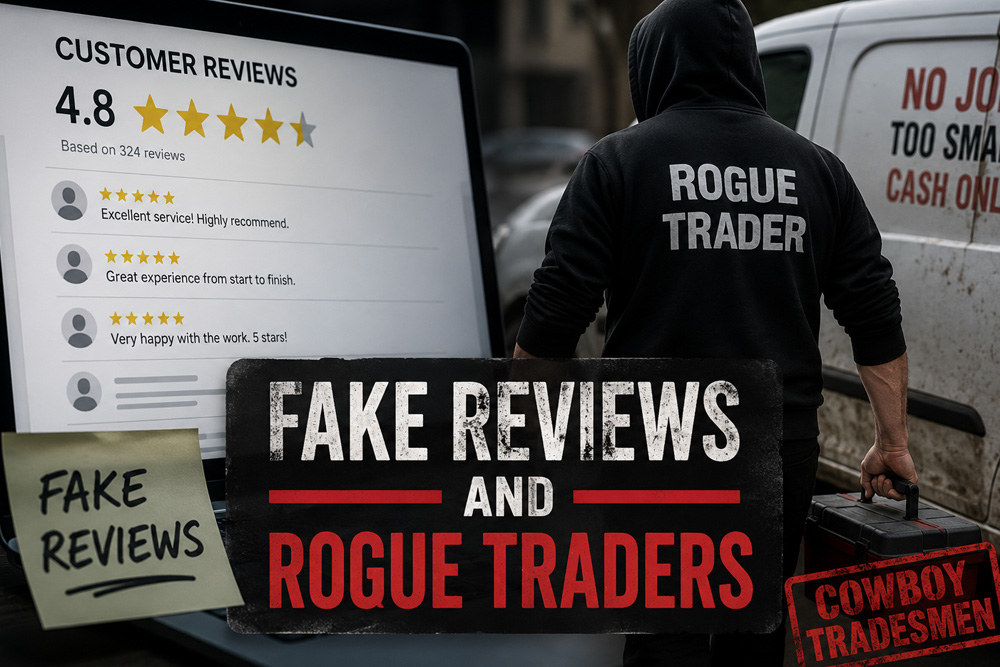
Online reviews have become one of the primary ways householders decide which tradespeople to trust. A business with dozens of five-star reviews on Google, Trustpilot, or Checkatrade appears to have a track record that justifies confidence. But review manipulation is widespread, and the review profile that persuaded you to engage a contractor may not reflect their actual reputation at all.
This article explains how rogue traders use fake reviews to attract clients, how to identify review manipulation, and what can be done about it.
How Fake Reviews Work
Buying positive reviews: a business purchases positive reviews from individuals or services who post them in exchange for payment. The reviews are fabricated; the reviewers have never used the business. This is a breach of platform terms and of consumer protection regulations.
Review gating: directing satisfied customers to leave reviews while discouraging or intercepting negative ones, artificially inflating the ratio of positive feedback.
Creating fake reviewer accounts: a business owner or their associates create multiple Google, Trustpilot, or Checkatrade accounts and post positive reviews of the business from each.
Coordinated attack reviews: posting negative reviews of a competitor from multiple accounts to damage their reputation. A business with a suspiciously clean review profile may have been the target of this kind of attack by a competitor.
How to Spot Fake Reviews
There are observable patterns that suggest review manipulation:
- A sudden cluster of reviews posted within a short period, particularly after a long gap, is inconsistent with organic review accumulation.
- Reviewer profiles with no other activity — no profile photograph, no other reviews — are often created solely for the purpose of leaving a review.
- Reviews that use similar language, similar sentence structures, or that address the same specific points in the same way may have been written by the same person or from a template.
- A high average rating with very few reviews, or a suspiciously large number of reviews for a business that does not appear to have the scale of customer base that would generate them organically.
- Negative reviews that all use highly similar language, or that attack specific aspects of a competitor’s business in an unusually coordinated way.
What Can Be Done
Where review manipulation has contributed to your decision to engage a rogue trader, it is relevant both to your civil claim — as evidence of misrepresentation — and to complaints to trading standards and consumer protection bodies. The Competition and Markets Authority has powers to investigate and act against businesses engaging in fake review practices.
Professional investigation can establish patterns of review manipulation that are not immediately obvious from a casual review of the profile, and can document those patterns in a form suitable for regulatory complaints and legal proceedings.
Suspect your contractor’s reviews were fake? Contact ARF Private Investigators to investigate.