
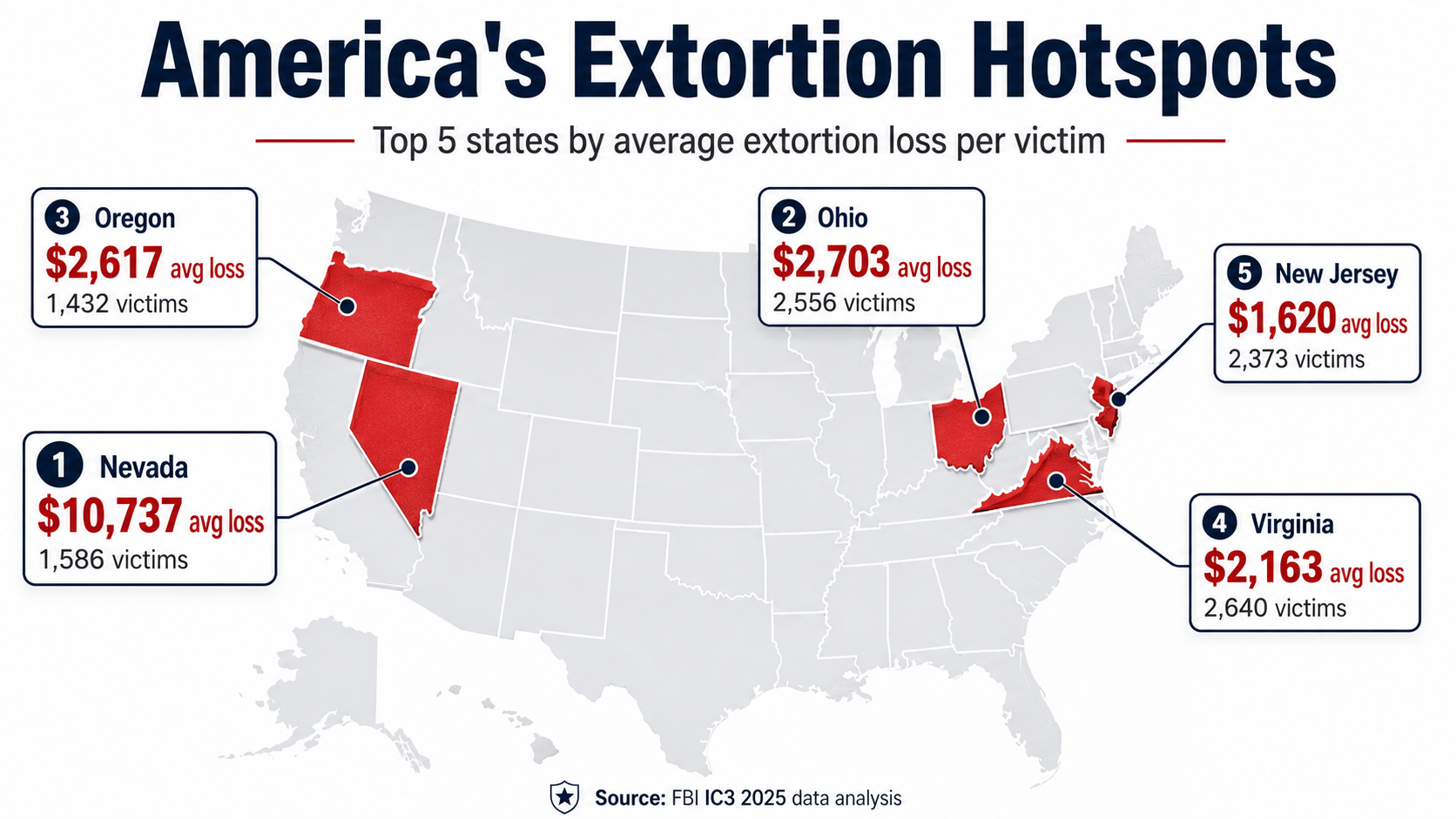
New research has revealed the US states where victims of extortion are losing the most money, with a huge difference between the highest and lowest-ranked parts of the country.
We analysed 2025 FBI Internet Crime Complaint Center data across all 50 states, looking at both the number of reported extortion victims and the amount of money they lost.
Rather than simply ranking states by the total number of victims, which would naturally favour more populated states, the study calculated the average financial loss per reported extortion victim.
The findings reveal some enormous differences.
Across all 50 states, more than 90,000 extortion victims were reported to the FBI’s IC3, with combined losses exceeding $109 million.
However, where somebody lived appears to make a huge difference to how much victims reported losing.
Nevada topped the ranking with 1,586 victims reporting combined losses of $17,028,773, equivalent to an average of approximately $10,737 per victim.
To put that into perspective, California recorded 11,911 victims, more than seven times Nevada’s figure, but total losses were only slightly higher at $17.4 million.
The average California victim reported losing around $1,461.
This means the average reported loss in Nevada was more than seven times higher than California, despite California recording considerably more victims.
America’s 10 biggest extortion hotspots
The following states recorded the highest average financial loss per reported extortion victim.
| Rank | State | Reported victims | Total reported losses | Average loss per victim |
|---|---|---|---|---|
| 1 | Nevada | 1,586 | $17,028,773 | $10,737 |
| 2 | Ohio | 2,556 | $6,908,159 | $2,703 |
| 3 | Oregon | 1,432 | $3,748,027 | $2,617 |
| 4 | Virginia | 2,640 | $5,709,947 | $2,163 |
| 5 | New Jersey | 2,373 | $3,845,310 | $1,620 |
| 6 | Nebraska | 483 | $762,893 | $1,579 |
| 7 | California | 11,911 | $17,403,200 | $1,461 |
| 8 | New Hampshire | 355 | $496,277 | $1,398 |
| 9 | Hawaii | 435 | $585,651 | $1,346 |
| 10 | New York | 5,036 | $6,685,472 | $1,328 |
Nevada is the clear outlier.
Its average reported loss was almost four times higher than Ohio, which came second in the ranking.
It is important to note that this doesn’t necessarily mean people living in Nevada are more likely to be targeted.
Instead, the data shows that when a financial loss was reported alongside an extortion complaint, the average amount lost was significantly higher.
The states where extortion victims lose the least
At the other end of the study, victims in several states reported considerably smaller average financial losses.
| Rank | State | Reported victims | Total reported losses | Average loss per victim |
|---|---|---|---|---|
| 1 | Idaho | 599 | $73,008 | $122 |
| 2 | Delaware | 281 | $61,179 | $218 |
| 3 | Rhode Island | 283 | $63,009 | $223 |
| 4 | Alaska | 378 | $95,197 | $252 |
| 5 | Kansas | 689 | $187,472 | $272 |
| 6 | New Mexico | 697 | $190,576 | $273 |
| 7 | Indiana | 1,541 | $426,253 | $277 |
| 8 | Arkansas | 664 | $207,797 | $313 |
| 9 | Maine | 318 | $111,615 | $351 |
| 10 | South Dakota | 232 | $90,092 | $388 |
The contrast between the two ends of the table is enormous.
The average reported extortion victim in Nevada lost around 88 times more money than the average victim in Idaho.
Why extortion can become so expensive
Extortion can cover a wide range of threats, from criminals claiming to hold private information to attempts involving intimate photographs, hacked accounts or threats to contact somebody’s employer, partner or family.
Paul Jones from ARF Investigations says one of the biggest dangers is that victims can feel pressured into making decisions quickly.
“Extortion works by creating panic. Someone is given a threat and made to feel that they have to pay immediately or something terrible will happen.
“The problem is that paying doesn’t necessarily make the threat disappear. Once somebody knows you’re prepared to send money, they may simply come back and ask for more.
“Keep copies of messages, usernames, phone numbers and payment requests, and don’t delete anything that could potentially be useful as evidence.”
Paul says people should also consider how much information they make publicly available online.
Social media accounts, dating profiles and even old posts can reveal information about someone’s relationships, employer, family or location, which can make an extortion attempt appear far more believable.
Full Data Table

Methodology
The America’s Extortion Hotspots study analysed 2025 data published by the FBI’s Internet Crime Complaint Center across all 50 US states.
For each state we recorded the number of victims categorised under Extortion and the total reported financial losses associated with those victims.
Average loss per victim was then calculated as:
Total reported extortion losses ÷ reported extortion victims
States were ranked according to the resulting average.
Washington, D.C. and US territories were excluded.
The FBI IC3 figures represent complaints and financial losses reported to the Internet Crime Complaint Center and should not be interpreted as representing every extortion incident occurring in each state.